The Pleasure Shock by Lone Frank
Author:Lone Frank
Language: eng
Format: epub
Publisher: Penguin Publishing Group
Published: 2018-03-20T04:00:00+00:00
* * *
• • •
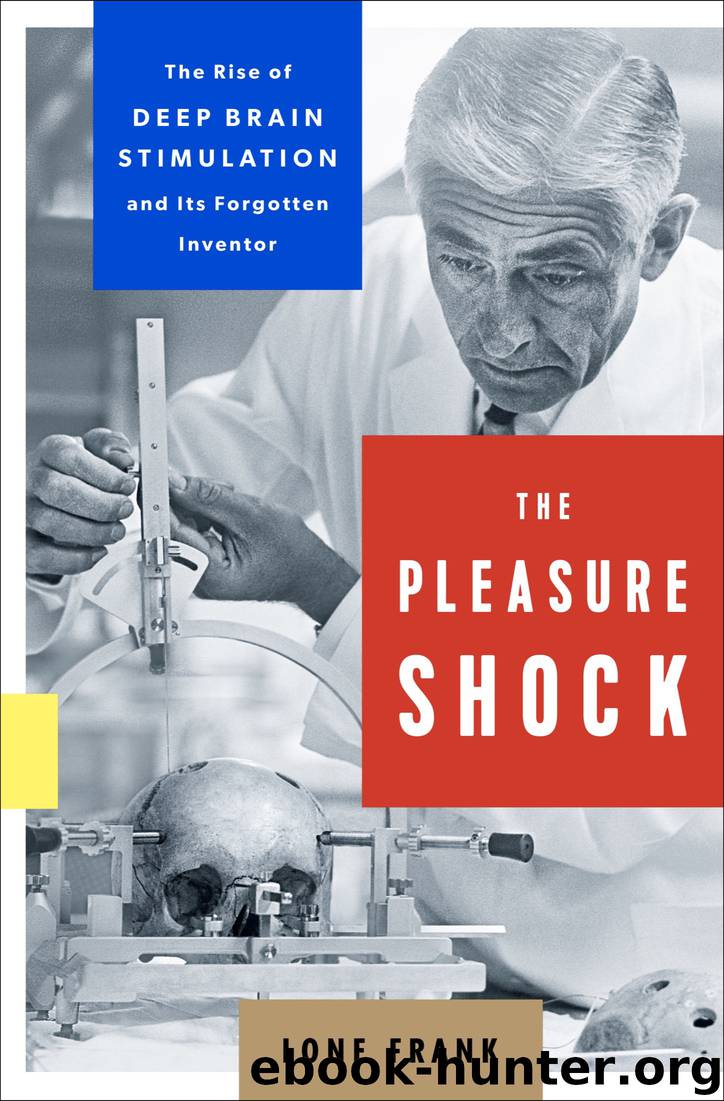
I understood what they were saying, these two academics. But I had a hard time agreeing with their one-sided judgment. I asked myself whether they might not be looking at Heath through today’s filters after the development over the interim years of what you could call the ethical landscape. The view of what is permissible in medical research has, after all, changed a lot.
Alan Baumeister himself actually pointed out that none of the otherwise so critical colleagues who gathered in New Orleans in 1952 to hear about the new research had raised a single ethical concern. Everything revolved around the science. And even I had a hard time seeing a breach in ethics from the perspective of that time. Yes, the operations were risky, but they took place in an era in which people were still doing lobotomies left and right, a time when everyone believed it was completely appropriate to cut up the frontal lobes of psychiatric patients even though many were injured for life.
Nor was the “treatment” of homosexuality alien to practitioners. At about the same time Heath was doing his experiments, it was not out of the ordinary for families in New Orleans to submit their homosexual sons to electroshock “cures.” They received up to forty shock treatments to “erase” the undesirable patterns of behavior, so a healthy and natural sexuality could be constructed. “Regressive ECT,” they called it. Other places, they tried to show the “patients” pictures of naked men and, at the same time, give them electric jolts to the testicles.
Electrical stimulation was generally used for things that, today, we would shake our heads at. Alan Baumeister told me—unsolicited—how he, as a psychology student at the end of the 1960s, helped to “train” retarded children to stop harming themselves by giving them electric shocks. I asked, of course, whether at that time and in that context the young Baumeister felt like a monster—the answer was no.
But what about me? This encounter with Heath’s critics makes me wonder whether I might be prejudiced in the opposite direction.
Because, honestly, I can’t say I’m not attracted to controversy. When I first heard about Robert Heath, the story grabbed me, and it was something that went deep. A haughty contempt for conventions was a fundamental feature of my upbringing. It was a mantra in our home that you should never worry about what “others” thought about you. “Do what you want to do, not what others want you to do,” my father might say. Being a yes-man was one of the worst things you could be guilty of, and the people who were admired in my family were those who stood out.
My immediate sympathy still goes to the weirdos, the people who don’t just go along but do something different. When it is comme il faut to be against genetically modified crops, I have to scrutinize the view and expose the emotional and irrational arguments it is based on. When it is popular to say
Download
This site does not store any files on its server. We only index and link to content provided by other sites. Please contact the content providers to delete copyright contents if any and email us, we'll remove relevant links or contents immediately.
| Africa | Americas |
| Arctic & Antarctica | Asia |
| Australia & Oceania | Europe |
| Middle East | Russia |
| United States | World |
| Ancient Civilizations | Military |
| Historical Study & Educational Resources |
Cat's cradle by Kurt Vonnegut(15441)
Pimp by Iceberg Slim(14664)
4 3 2 1: A Novel by Paul Auster(12509)
Underground: A Human History of the Worlds Beneath Our Feet by Will Hunt(12144)
The Radium Girls by Kate Moore(12090)
Wiseguy by Nicholas Pileggi(5841)
The Fire Next Time by James Baldwin(5503)
Perfect Rhythm by Jae(5460)
American History Stories, Volume III (Yesterday's Classics) by Pratt Mara L(5337)
Paper Towns by Green John(5247)
Pale Blue Dot by Carl Sagan(5079)
A Higher Loyalty: Truth, Lies, and Leadership by James Comey(5017)
The Mayflower and the Pilgrims' New World by Nathaniel Philbrick(4540)
The Doomsday Machine by Daniel Ellsberg(4538)
Killers of the Flower Moon: The Osage Murders and the Birth of the FBI by David Grann(4488)
The Sympathizer by Viet Thanh Nguyen(4443)
Too Much and Not the Mood by Durga Chew-Bose(4386)
The Borden Murders by Sarah Miller(4377)
Sticky Fingers by Joe Hagan(4253)
